Things to See and Do in Kigali
Kigali is ranked among Africa’s cleanest and safest capitals, a distinction that shows up the moment you step outside the airport: swept streets, disciplined traffic, no plastic bags at customs, and a calm that surprises travelers who arrive expecting the chaos typical of many capital cities.
It is also a city with genuine substance — a sobering, essential memorial, a contemporary art scene that has earned international attention, neighborhood markets that still run on decades-old rhythms, and a coffee culture built on some of the best arabica beans grown anywhere in the world.
We plan Kigali time into nearly every Rwanda itinerary we build, not as padding around gorilla trekking but as a deliberate part of the trip. This guide covers what’s actually worth doing, how much time each activity needs, what it costs, and how to sequence it around your time in Volcanoes National Park.
How Much Time to Budget in Kigali
The short answer: at least one full day, and ideally two. A single day is enough to visit the Genocide Memorial and add one more activity a market visit, an art gallery stop, or a neighborhood walk without feeling rushed.
Two days lets you spread the memorial visit (which is emotionally heavy and deserves a slower afternoon afterward) across one day, and dedicate the second to markets, art, food, and a proper coffee tour.
Because Volcanoes National Park is only a two to two-and-a-half hour drive from Kigali, roughly 104 to 116 kilometers depending on the route and your final lodge, many travelers are tempted to skip Kigali entirely and transfer straight through on arrival and departure days. We’d steer most clients away from that plan.
Flights from Europe and North America typically land in Kigali in the evening or overnight, which means your first morning is usually needed for rest, not a mountain drive on jet lag.
Building in one night in Kigali before heading to the volcanoes, and one or two nights after your trek, gives you a buffer for flight delays, a shower and proper meal after a muddy trekking day, and a far more balanced trip than back-to-back travel days.
If your schedule is genuinely tight, a half day is still workable. Arrive in the morning, visit the Genocide Memorial before lunch, and continue to Musanze that afternoon—the drive comfortably fits into an afternoon slot.
But if you have any flexibility at all, we’d recommend claiming the extra day. Clients who add it consistently tell us it changed how they understood the rest of their Rwanda trip.
Kigali at a Glance: Top Things to Do
Here’s how the main activities compare on time, cost, and who they suit best. Cost tiers are relative: $ means under roughly $15–20 per person, $$ covers $20–60, and $$$ applies to full-day excursions or park activities in the $60–150+ range.
|
Activity |
Time Needed |
Cost Tier |
Best For |
|
Kigali Genocide Memorial |
1.5–2 hours |
Free (donation appreciated) |
All travelers — widely considered essential context for understanding modern Rwanda |
|
Kimironko Market |
1–1.5 hours |
$ (cash purchases only) |
Travelers who enjoy local color, produce, fabric and bargaining |
|
Inema Arts Center |
45 min–1.5 hours |
Free entry / $$ for art |
Art lovers, collectors, and anyone visiting on a Friday evening |
|
Nyamirambo walking tour |
2.5–3 hours |
$$ (guided, includes lunch option) |
First-time visitors wanting authentic neighborhood context |
|
Coffee tour / cafe crawl |
1–2 hours |
$ to $$ |
Coffee enthusiasts and travelers wanting a relaxed afternoon |
|
Caplaki Craft Village |
45 min–1 hour |
$ to $$ |
Souvenir and gift shopping in one stop |
|
Mount Kigali viewpoint |
1.5–2 hours |
$ to $$ |
Travelers wanting skyline views, a walk, or a zipline |
|
Kigali city / genocide sites tour (guided, half-day) |
4–5 hours |
$$ |
Travelers who prefer a single organized half-day covering memorial plus city highlights |
|
Akagera National Park (day trip) |
Full day (10–12 hrs round-trip) |
$$$ |
Travelers with an extra day who want a Big Five safari without leaving central Rwanda |
|
Nyungwe Forest National Park |
2–3 days recommended (not a day trip) |
$$$ |
Travelers extending their itinerary for chimpanzee trekking or the canopy walkway |
Kigali Genocide Memorial
The Kigali Genocide Memorial, in the Gisozi neighborhood about ten minutes from the city center, is the resting place of more than 250,000 victims of the 1994 genocide against the Tutsi, and it functions as both a burial ground and a museum documenting how the genocide happened and why.
For most travelers, this is the single most important stop in Kigali — not because it’s listed in guidebooks, but because it provides context that makes the rest of Rwanda, and the resilience visible in its cities and communities today, make sense.
We’re direct with clients about what to expect: this is not a light museum visit. The exhibits move chronologically through the history that led to the genocide, the events of 1994 themselves, and a section dedicated to children who were killed, which many visitors find the hardest part of the visit.
Plan for at least one and a half to two hours to see the museum and gardens properly. Entrance is free, though the memorial relies on donations to fund its educational work and upkeep, and most visitors choose to contribute. An audio guide is available and worth the small additional cost — it adds detail and pacing that make the exhibits easier to absorb.
A few practical points worth knowing before you go. Children under 12 are not permitted inside, so families traveling with younger kids will need to plan alternate activities or split up for a couple of hours. Photography is not allowed inside the exhibition halls, though it’s permitted in the gardens outside. Eating and drinking aren’t allowed anywhere on site.
The memorial is open daily from 9 a.m. to 5 p.m. (last entry 4 p.m.), with a shortened 1 p.m. to 5 p.m. schedule on the last Saturday of each month due to Umuganda, Rwanda’s nationwide community work morning. It’s closed on Christmas Day, New Year’s Day, and the morning of April 7th, the start of the annual Kwibuka commemoration period.
On sensitivity: this is a place of mourning as much as it is a museum, and Rwandans visit it too, often to grieve family members buried there.
Guides are respectful and measured rather than dramatic, and many are genocide survivors themselves, which lends a directness to the tours that we’ve found visitors respect rather than find uncomfortable.
We’d suggest scheduling the memorial for the morning, then keeping the rest of that day relaxed—a slow lunch, a walk, or simply downtime at your hotel. Trying to pack high-energy activities immediately afterward tends to feel jarring.
Kimironko Market
Kimironko is Kigali’s largest and most active public market, and it’s where the city actually shops — not a curated tourist stall, but a working market spread across multiple covered halls selling fresh produce, dried beans and grains, fabric by the meter, secondhand clothing, woven baskets, and household goods.
It rewards travelers who enjoy a bit of sensory overload: the fabric section alone, with its stacked bolts of kitenge and kente prints, is worth forty-five minutes on its own if you’re interested in having something tailored.
Budget an hour to an hour and a half. Bring small denominations of Rwandan francs, since card payment isn’t standard here, and expect to negotiate on price for anything beyond fresh produce — light bargaining is normal and expected, though Rwanda’s markets are notably less aggressive about it than markets in some neighboring countries.
If you want fabric made into clothing, several tailors work right at the market and can turn around a simple piece within a day or two, which is worth knowing if you’re not departing immediately.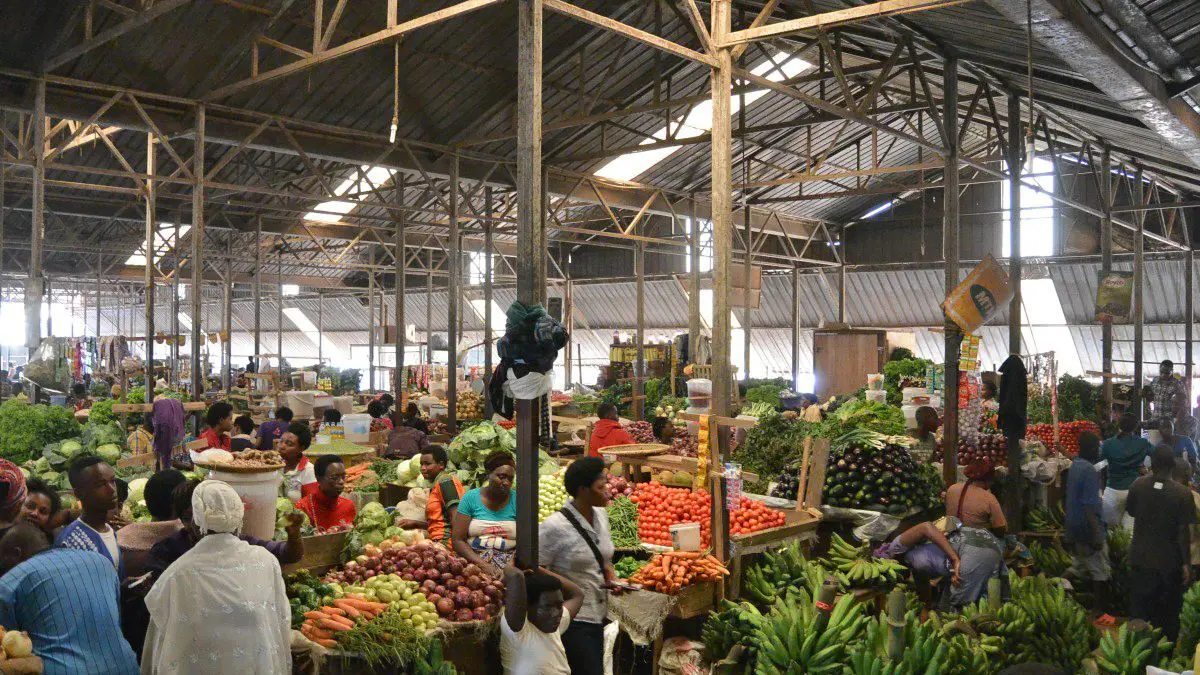
For travelers who’d rather shop for finished handicrafts than raw fabric, Caplaki Craft Village is the better stop — a cluster of stalls near the city center selling woodcarvings, basketry, jewelry, and paintings, with less crowd density and an easier pace than Kimironko. Many of our clients do both: Kimironko for atmosphere and fabric, Caplaki for gifts to pack home.
Inema Arts Center and Kigali’s Contemporary Art Scene
Kigali’s art scene has grown fast, and Inema Arts Center, founded in 2012 by brothers Emmanuel and Innocent Nkurunziza, is its anchor. The gallery represents some of Rwanda’s most prominent contemporary painters, many of whom work on site in open studios, so visitors can watch pieces being made rather than just viewing finished work on a wall.
Themes tend toward memory, identity, and transformation — unsurprising given the country’s history, but rendered here in bold, contemporary style rather than anything overtly heavy.
Entry to browse the gallery is free, and pieces are for sale if something catches your eye — Inema can arrange shipping for larger works. If your visit lines up with a Friday evening, the center hosts a casual open-air social that draws a genuine mix of local artists, diplomats, NGO staff, and travelers; it’s one of the better ways to meet Kigali residents rather than just pass through as a tourist. Plan 45 minutes for a straightforward gallery visit, or up to 90 minutes if you stay for a drink and conversation.
Pair it with the Rwanda Art Museum, housed in the former Presidential Palace, which covers both contemporary work and exhibits on the country’s political history, including the preserved wreckage of the presidential plane shot down in 1994 — a site with its own historical weight worth knowing about before you visit.
Nyamirambo:
If Kigali’s city center feels polished and modern, Nyamirambo is its opposite: older, denser, and considerably more textured. It’s one of the city’s oldest neighborhoods and home to a significant Muslim community, so you’ll hear the call to prayer from the mosque, pass Somali sambusa vendors, and walk streets lined with tailors, hair salons, and family-run shops that have operated for generations.
The best way to experience it is a guided walking tour run by the Nyamirambo Women’s Center, a community initiative that trains and employs local women as guides.
Tours typically run two and a half to three hours and take you through the market, into a working tailor’s shop, past a hair salon, and often end with a home-cooked Rwandan lunch with a local family — a level of access you wouldn’t get wandering on your own.
It’s a genuinely different register of travel experience than the memorial or the galleries: lighter, warmer, and centered on everyday life rather than history or art.
We recommend Nyamirambo especially for travelers who’ve already done a fair amount of museum-and-monument travel elsewhere in Africa and want something that feels more like meeting people than checking off a sight. It’s also a good option to pair with the afternoon after a Genocide Memorial visit — the contrast between the two experiences tends to land well rather than feeling mismatched.
Coffee Culture and Cafes
Rwanda grows some of the best arabica coffee in the world, largely thanks to the country’s high altitude, volcanic soil, and a post-genocide push to rebuild the coffee sector as a source of national income and reconciliation. Kigali is where that quality reaches the cup, and a coffee stop belongs on nearly every itinerary, gorilla trekkers included.
Question Coffee is the standout for travelers who want to understand the process rather than just drink the result — it runs seed-to-cup experiences and cupping sessions that walk you through sourcing, roasting, and tasting, largely staffed and run by women coffee professionals.
For a more straightforward cafe stop, Bourbon Coffee and Shokola Café are reliable, comfortable spots for a proper espresso or pour-over, both with locations convenient to the city center and good for an hour of downtime, wifi, and people-watching.
None of this requires advance planning — treat coffee as something you work into gaps between other activities rather than a scheduled excursion, unless you book the Question Coffee experience, which is worth reserving a day ahead.
Where to Eat
Kigali’s dining scene has matured considerably over the past decade, and a couple of nights out here are worth building into your schedule rather than treating dinner as an afterthought before an early departure.
Heaven Restaurant & Boutique Hotel, in the Kimihurura neighborhood, is the city’s best-known dinner destination — an international and fusion menu served on a garden terrace with Kigali hills in view. It’s popular enough with both residents and visitors that a reservation seven to ten days ahead is a good idea if your dates are set.
Repub Lounge is the strongest alternative when Heaven is booked, or worth choosing on its own merits — a rooftop space with Afro-fusion small plates, local specialties like brochettes and sambaza (small lake fish), and a livelier, more social atmosphere than Heaven’s quieter garden setting.
Beyond those two anchors, Kigali has a growing list of solid mid-range options for Rwandan, Ethiopian, Indian, and Italian food, and most hotel restaurants — particularly at the Marriott, Radisson Blu, and Serena — are dependable if you’d rather not venture out after a long travel day.
Where to Stay
Kigali’s hotel landscape spans from full-service five-star properties to comfortable boutique guesthouses, and where you base yourself matters less here than in most cities — traffic is light, distances are short, and a moto or Yego cab ride between neighborhoods rarely takes more than 15–20 minutes.
• Kigali Marriott Hotel — centrally located near the financial district and convention center, with the polish and consistency business travelers expect. A dependable choice if you want a familiar international standard.
• Radisson Blu Hotel & Convention Centre — a well-regarded five-star property with strong service and a design that draws on local culture and materials rather than generic international style.
• Kigali Serena Hotel — centrally located in the Sports City area, roughly ten minutes from the airport, and a favorite for travelers who want a quieter, garden-style property over a high-rise.
• Boutique and smaller properties — Kigali also has a good range of smaller boutique hotels and guesthouses, often better suited to travelers who prefer a more personal, less corporate feel, and typically at a lower price point than the international chains.
For most of our clients, we recommend staying centrally — within easy reach of the city center and Kimihurura — rather than near the airport, since it puts you closer to restaurants, galleries, and the memorial, and the airport itself is only a 15–20 minute drive from most central hotels.
Getting Around, Safety, and Connecting to Gorilla Trekking
Getting Around
Kigali doesn’t have a metro or reliable public transit system geared toward visitors, but getting around is easy and inexpensive. The Yego app is the simplest option — a Rwanda-specific ride-hailing service offering both car (Cab) and motorcycle (Moto) options, with regulated, distance-based fares and no surge pricing.
Motorcycle taxis are the fastest way to cover short distances and are heavily regulated in Rwanda — drivers are licensed and insured, and helmets are mandatory for both driver and passenger — but a car is the more comfortable choice for longer trips or if you’re carrying luggage. Fares for short trips typically run 500–2,000 Rwandan francs; agree on the price (or confirm it through the app) before you set off.
Currency and Payments
The Rwandan franc (RWF) is the local currency, and while USD is sometimes accepted for larger purchases like hotels and tour bookings, everyday transactions — markets, motos, small restaurants — run on francs.
Carry small denominations; drivers and market vendors often can’t break large notes. Cards are accepted at hotels, larger restaurants, and supermarkets, but it’s worth carrying cash for markets and informal transport.
Safety and Etiquette
Kigali’s reputation for safety is well earned — strict regulations around cleanliness (plastic bags are banned nationwide) and public order extend to genuinely low crime rates in the areas travelers frequent.
That said, ordinary city precautions still apply: keep valuables out of sight, use official transport after dark, and stick to licensed guides for tours. Rwanda is socially conservative, so modest dress — covering shoulders and knees — is appreciated, particularly at the memorial and in neighborhoods like Nyamirambo.
Connecting to Volcanoes National Park and Gorilla Trekking
Volcanoes National Park, the base for gorilla trekking, sits roughly 104–116 kilometers northwest of Kigali in the Musanze area, a drive of two to two and a half hours on a good, mostly paved road.
This proximity is one of the practical advantages of Rwanda over other gorilla trekking destinations — it makes a same-day drive-and-trek possible in a pinch, though we generally recommend spending at least one night in the Musanze area before your trek so you’re not tackling a demanding hike on travel fatigue.
Gorilla permits ($1,500 per person as of this writing) sell out well in advance during peak months, so permit booking should happen months ahead of travel, ideally as one of the first pieces of your itinerary to lock in Kigali time and lodge selections can be built around the permit dates once they’re confirmed.
If you’re combining Kigali with trekking, the most common and comfortable sequence is: arrive in Kigali, spend a day or two in the city, transfer to Musanze the day before your trek, trek, then return to Kigali for a final night or two before departure. This spreads the driving across the trip rather than stacking it all on one exhausting day.
Worth the Extra Days: Akagera and Nyungwe
For travelers with more time, Kigali is also a reasonable base for reaching two of Rwanda’s other parks, though they suit different kinds of trips.
Akagera National Park, about 110 kilometers east of Kigali and a two-to-three-hour drive, is a genuine Big Five savanna park lions and rhinos have both been successfully reintroduced in the past decade and can be done as a long day trip from Kigali if your schedule is tight, though an overnight inside the park makes for a far better game-viewing experience.
Nyungwe Forest National Park, home to chimpanzee trekking and East Africa’s highest canopy walkway, is farther out at 218–226 kilometers and four to seven hours’ drive depending on road conditions — this one isn’t a realistic day trip and needs at least two to three days added to your itinerary, usually as an extension after gorilla trekking rather than a Kigali add-on.