Akagera and Nyungwe National Park Safari: A Complete Combined Itinerary Guide; Combining Akagera National Park with Nyungwe Forest gives travellers a genuinely complete picture of Rwanda’s non-gorilla wildlife experience: the Big Five savannah safari at Akagera in the east, paired with Africa’s oldest and one of its most significant rainforests at Nyungwe in the southwest, home to chimpanzee tracking, a dozen other primate species, and a canopy walkway suspended above the forest floor.
This combination works particularly well for travellers who either don’t have gorilla trekking permits available, want to add genuine depth beyond Volcanoes National Park, or are specifically building a wildlife-and-rainforest circuit rather than a primate-trekking-only trip.
This guide covers how to combine Akagera and Nyungwe effectively: the logistics of connecting the two parks, what each contributes to the itinerary, how long to allocate to each, and the practical planning considerations that make the difference between a rushed combination and a genuinely rewarding one.
Why Combine Akagera and Nyungwe?
Akagera and Nyungwe sit at opposite ends of Rwanda geographically and offer almost entirely complementary experiences. Akagera delivers Rwanda’s only savannah safari, with all Big Five species present following a remarkable conservation recovery, wetland birding, and the Lake Ihema boat cruise. Nyungwe delivers montane rainforest, chimpanzee tracking, a dozen other primate species including habituated troops of black-and-white colobus monkeys numbering in the hundreds, and some of the finest birding in the country, including the country’s Africa’s oldest rainforest.
This combination suits travellers who want genuine variety within a Rwanda trip beyond gorilla trekking, or who are specifically prioritising savannah wildlife and forest primates over mountain gorillas, perhaps because gorilla permits weren’t available for their dates, budget didn’t extend to the gorilla permit, or they’ve done gorilla trekking previously and want to add new experiences on a return visit.
Understanding How Akagera and Nyungwe Complement Each Other
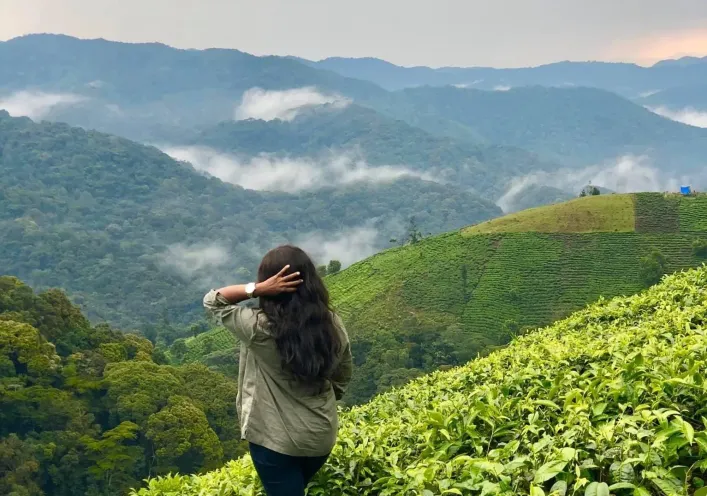
The contrast between these two parks is close to total, and that’s precisely what makes the combination work. Akagera’s landscape is open savannah, acacia woodland and wetland, a large sky, big herds and the visual drama of classic African plains safari. Nyungwe’s landscape is closed-canopy montane rainforest, humid, dense and vertically structured, with a completely different rhythm of wildlife encounter built around primate tracking and patient, quiet forest walking rather than open vehicle-based game drives.
Akagera’s Big Five recovery story, lions reintroduced in 2015, black rhino in 2017 and 2019, white rhino in 2021 and 2025, gives the park a specific conservation narrative that most first-time visitors find genuinely compelling once they understand it. Nyungwe’s significance is different: as one of Africa’s oldest rainforests, estimated to have survived largely intact through multiple ice ages, it holds an exceptional concentration of Albertine Rift endemic species, thirteen primate species including chimpanzees and Rwenzori colobus troops that can number over 300 individuals, and a canopy walkway that gives a genuinely unique vantage point over the forest.
Geographically, the two parks sit roughly at opposite corners of Rwanda, Akagera hard against the Tanzanian border in the east, Nyungwe in the far southwest near the Burundi border, which means a combined itinerary genuinely traverses the country and, if routed through Kigali, Butare (Huye) and the southern towns, gives a comprehensive sense of Rwanda’s geography beyond the northern gorilla trekking circuit.
Akagera vs Nyungwe: What Each Delivers
Here is a direct comparison of what each park specifically contributes to a combined itinerary.
| Variable | Akagera National Park | Nyungwe Forest National Park |
| Landscape | Open savannah, acacia woodland, lakes and wetland | Dense montane rainforest, Africa’s oldest surviving forest |
| Signature wildlife | Big Five (lion, leopard, elephant, buffalo, black and white rhino) | Chimpanzees, Rwenzori colobus (troops of 300+), 12 other primate species |
| Primary activity | Game drives, Lake Ihema boat cruise | Chimpanzee tracking, colobus monkey tracking, canopy walk |
| Birding strength | Wetland and savannah specialists, 525+ species, shoebill possibility | Montane forest and Albertine Rift endemics, around 310 species |
| Typical stay length | 2-3 nights | 2-3 nights |
| Distance from Kigali | ~2-2.5 hours (southern gate) | ~5-6 hours (or via Butare/Huye) |
Structuring the Akagera and Nyungwe Combination
There are two practical route structures for combining these two parks, and understanding both helps you choose the one that best fits your overall Rwanda itinerary.
Route One: Akagera First, Then Nyungwe via Kigali and the South
The most common structure starts in Kigali, moves east to Akagera for two to three nights, returns to Kigali, then continues south and west to Nyungwe, typically stopping in Huye (Butare) en route, home to Rwanda’s National Ethnographic Museum, before continuing to Nyungwe for a further two to three nights. This structure uses Kigali as a natural hub between the two parks and allows a comfortable overnight break in Huye if the full Nyungwe drive in a single day feels excessive.
Route Two: Nyungwe First, Then Akagera
Reversing the order, beginning with Nyungwe and concluding at Akagera before returning to Kigali for departure, works equally well and may suit travellers whose international flight schedule favours ending nearer Kigali’s airport after the shorter Akagera return leg rather than the longer Nyungwe transfer.
Combining with Volcanoes National Park for a Three-Park Circuit
For travellers with enough time, adding Volcanoes National Park to this combination creates a genuinely comprehensive Rwanda circuit covering gorilla trekking, savannah Big Five safari and rainforest primate tracking within a single trip. This requires a longer overall itinerary, typically twelve to sixteen days, but delivers the country’s full range of signature wildlife experiences.
The Huye (Butare) Stopover
Huye, roughly midway on the road between Kigali and Nyungwe, is a natural stopover point, home to the National Ethnographic Museum with its strong collection of traditional Rwandan artefacts, and a sensible place to break the longer Nyungwe leg of the journey rather than attempting the full transfer in a single push, particularly if combined with an Akagera visit on the same trip.
Best Time for an Akagera and Nyungwe Combined Safari
Both parks are accessible year-round, but their seasonal considerations differ slightly. Akagera’s dry seasons, June through September and December through February, offer the most concentrated wildlife viewing as animals gather around permanent water sources. Nyungwe, as a genuine rainforest, receives significant rainfall even during Rwanda’s nominal dry season, and while the dry months offer somewhat easier trekking conditions, chimpanzee and colobus tracking remain productive and rewarding across the year.
The combination works well in any season, though travellers specifically prioritising the strongest possible Akagera game viewing should lean toward the dry season months, while Nyungwe’s primate tracking is less season-dependent overall.
| Season | Months | Akagera Conditions | Nyungwe Conditions |
| Long dry season | June – September | Best game viewing; wildlife concentrates at water | Good trekking; still regular rainfall as a rainforest |
| Short dry season | December – February | Strong game viewing | Good trekking conditions |
| Long rains | March – May | Wildlife more dispersed | Lush; primate tracking remains productive |
| Short rains | October – November | Moderate conditions | Good; migrant birds arriving |
What Does an Akagera and Nyungwe Safari Cost?
This combination is considerably more affordable than any itinerary including gorilla trekking, since neither Akagera’s park fees and activity costs nor Nyungwe’s chimpanzee tracking and canopy walk fees approach the premium pricing of a gorilla permit. This makes the Akagera and Nyungwe combination one of the most cost-effective ways to experience substantial, genuine Rwandan wildlife.
The main costs are park entry fees at both parks, Akagera’s specific activity fees (boat cruise, rhino tracking, fishing permits if desired), Nyungwe’s chimpanzee tracking permit and canopy walk fee, accommodation at both ends, and the transport connecting them, whether by private vehicle across the country or via Kigali with a rental or hired vehicle for each leg.
Budget combination — Budget accommodation, shared or self-drive transport
Budget lodges or campsites at Akagera, budget accommodation near Nyungwe, and self-drive or shared transport between the two via Kigali. This is one of the most affordable substantial wildlife itineraries available in East Africa.
Mid-range combination — Comfortable lodges, private vehicle throughout
Mid-range lodges at both Akagera and Nyungwe, a private guided vehicle for the full circuit, the Lake Ihema boat cruise, chimpanzee tracking and the canopy walk. This is where most of our Akagera-Nyungwe bookings sit.
Luxury combination — Premium lodges, private guide throughout
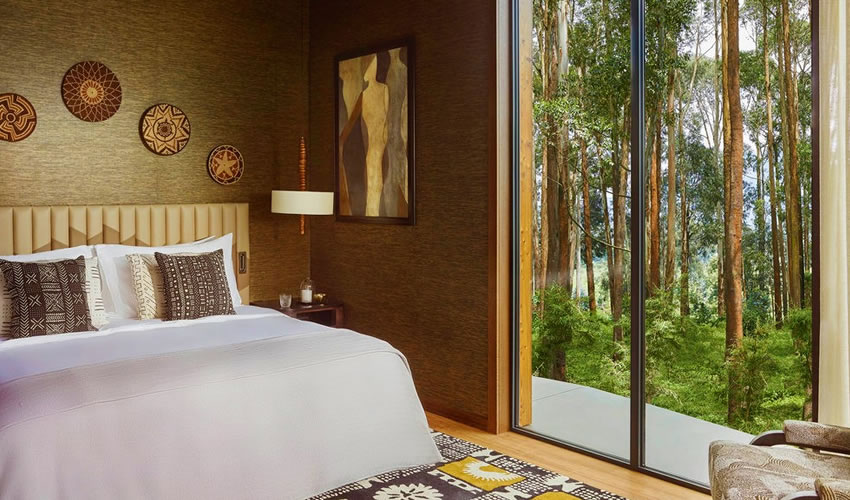
Magashi Safari Camp at Akagera and One&Only Nyungwe House or Nyungwe Forest Lodge, private vehicle and guide throughout, rhino tracking at Akagera, and a comprehensive Nyungwe primate and birding programme.
Where to Stay for an Akagera and Nyungwe Combination
Accommodation at each park should be chosen independently based on the tier and specific location within each park that best suits your priorities, since the two parks don’t share any accommodation infrastructure given their distance apart.
| Park | Budget Option | Mid-Range Option | Luxury Option |
| Akagera National Park | Shakani, Muyumba or Mutumba campsites | Ruzizi Tented Camp, Mantis Akagera Game Lodge | Magashi Safari Camp |
| Nyungwe Forest National Park | Basic forest lodges near the park | Nyungwe Forest Lodge | One&Only Nyungwe House |
| Huye (Butare) stopover | Local guesthouses | Ibis Huye Hotel or similar | Limited premium options; typically a one-night practical stop |
What to Do at Each Park
Structuring your time well at each park makes the most of the combination.
At Akagera: Game Drives
A full south-to-north game drive circuit covering Akagera’s varied habitat gives the best chance of the full Big Five, with buffalo and elephant close to guaranteed, lion odds strong given the recovering reintroduced population, and rhino tracking, a dedicated activity joining rangers on their monitoring rounds, significantly improving odds of both black and white rhino sightings.
At Akagera: Lake Ihema Boat Cruise
The boat cruise on Lake Ihema is widely regarded as Akagera’s standout activity, bringing visitors close to hippo pods, Nile crocodile and an exceptional range of waterbirds, with departures at 7:30am, 9am, 3pm and 4:30pm.
At Nyungwe: Chimpanzee Tracking
Nyungwe’s chimpanzee community is less consistently easy to locate than Uganda’s Kibale Forest, since the troop ranges over a considerably larger area, but a successful tracking morning delivers a genuinely rewarding rainforest primate encounter, requiring an early departure and a reasonable level of fitness for forest walking on sometimes steep terrain.
At Nyungwe: Colobus Monkey Tracking
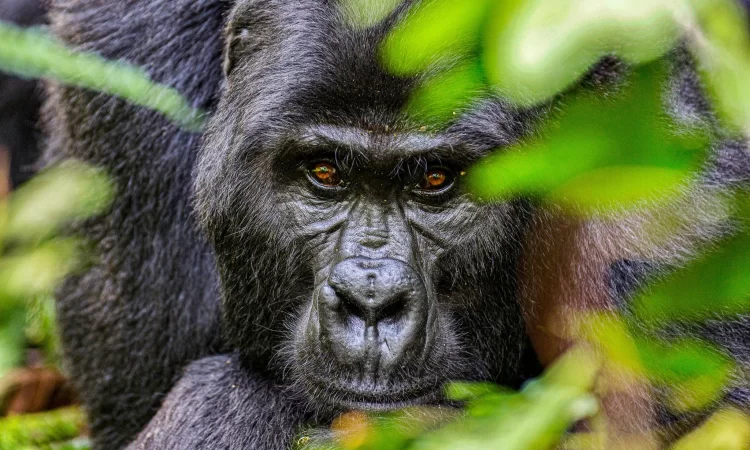
Nyungwe’s Rwenzori colobus troops, some of the largest habituated primate groups in Africa at over 300 individuals in a single troop, offer one of the most visually spectacular primate encounters available in Rwanda, with the black-and-white colobus moving through the canopy in genuinely large numbers.
At Nyungwe: The Canopy Walkway
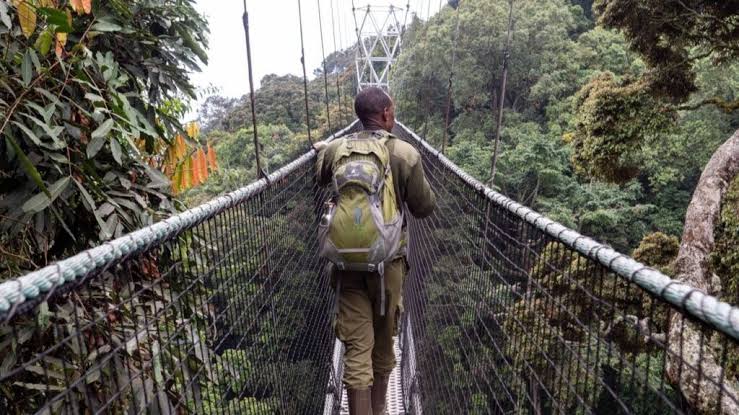
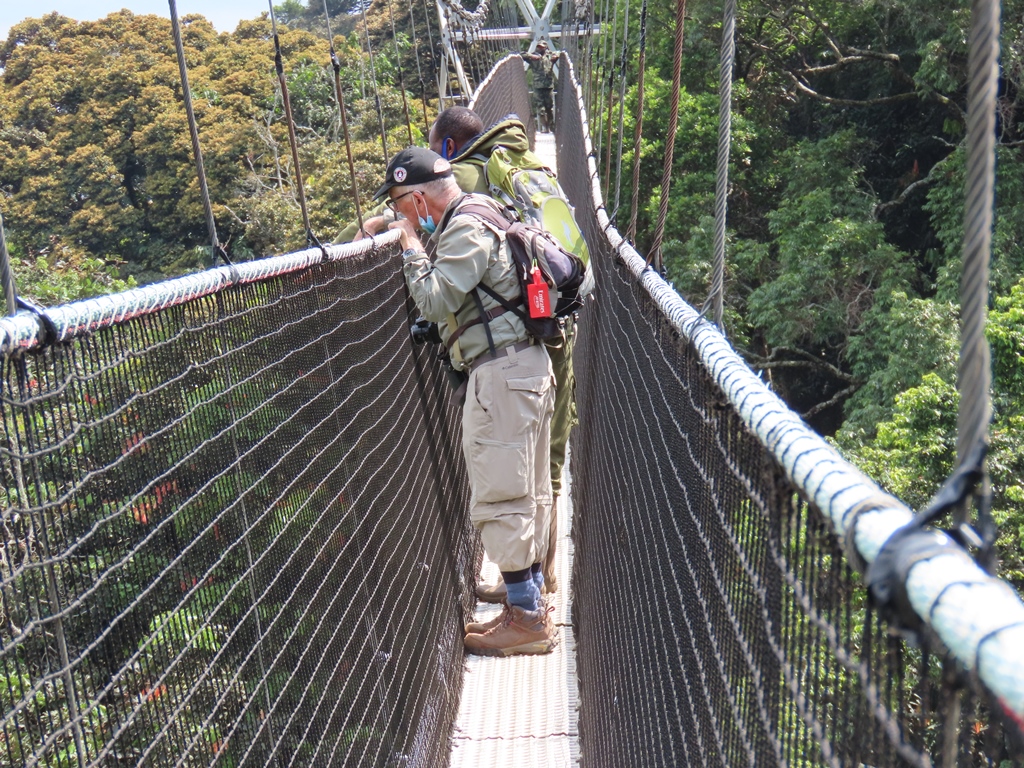
Nyungwe’s canopy walkway, suspended high above the forest floor, gives a unique vantage point over the rainforest canopy and is one of the most distinctive activities available in Rwanda, offering both a different wildlife-viewing perspective and a memorable experience in its own right for travellers with a good head for heights.
| Activity | Park | Duration | Advance Booking? |
| Full game drive circuit | Akagera | Full day | No, but recommended through operator |
| Rhino tracking | Akagera | Half day | Yes, arrange through park or operator |
| Lake Ihema boat cruise | Akagera | 1.5-2 hours | Yes, especially peak season |
| Chimpanzee tracking | Nyungwe | Half day | Yes; permits limited |
| Colobus monkey tracking | Nyungwe | Half day | Recommended |
| Canopy walkway | Nyungwe | 1-2 hours | Recommended |
Practical Planning for the Combination
A minimum of five to six nights, three at Akagera and two to three at Nyungwe, gives both parks reasonable time without feeling rushed. Seven to eight nights allows a more comfortable pace with a proper stopover in Huye and less pressure on any single day’s activities.
The transfer between the two parks is genuinely significant, and building it into your itinerary as a full travel day, or two shorter days with a Huye stopover, rather than assuming it can be combined with a activity day at either end, avoids an exhausting and counterproductive rush.
Since neither park requires the same premium booking lead time as gorilla trekking, this combination offers more scheduling flexibility than a gorilla-inclusive itinerary, though chimpanzee tracking permits at Nyungwe and rhino tracking at Akagera still benefit from advance booking.
Who Should Choose This Combination
Here is a direct guide to which traveller types benefit most from an Akagera and Nyungwe combined safari.
| Traveller Type | Recommendation | Why |
| Budget-conscious wildlife travellers | Strongly recommended | Avoids the premium gorilla permit cost while delivering substantial genuine wildlife |
| Repeat Rwanda visitors | Strongly recommended | Adds genuine new experiences beyond a previous gorilla trekking trip |
| Birders | Strongly recommended | Covers both wetland/savannah and montane forest species categories |
| First-time visitors specifically wanting gorilla trekking | Add Volcanoes National Park to this combination | This itinerary alone doesn’t include gorillas |
| Travellers with limited time (under 5 days) | Consider choosing one park rather than both | The transfer between the two is genuinely significant |
Frequently Asked Questions
How far apart are Akagera and Nyungwe National Parks?
They sit at opposite corners of Rwanda, with Akagera in the east near the Tanzanian border and Nyungwe in the southwest near Burundi. The drive between them, typically routed via Kigali, takes a full day or can be split across two days with a stopover in Huye (Butare).
Can you do Akagera and Nyungwe without gorilla trekking permits?
Yes, and this combination is specifically built for travellers who aren’t including gorilla trekking, whether by choice, budget or permit availability. Both parks offer substantial, rewarding wildlife experiences independent of Volcanoes National Park.
How many nights should I allocate to each park?
Two to three nights at Akagera and two to three nights at Nyungwe is the standard recommendation, giving each park reasonable time for its signature activities without rushing.
Is this combination cheaper than including gorilla trekking?
Yes, considerably. Neither Akagera’s nor Nyungwe’s activity fees approach the cost of a gorilla trekking permit, making this one of the most cost-effective substantial wildlife itineraries available in Rwanda.
What is the best route order: Akagera first or Nyungwe first?
Either works well. Starting with Akagera and finishing at Nyungwe, or the reverse, both deliver the same overall experience, and the choice often comes down to which fits your international flight schedule and overall Rwanda itinerary better.
Can I add Volcanoes National Park to this combination?
Yes, and this creates a comprehensive three-park Rwanda circuit covering gorilla trekking, Big Five safari and rainforest primate tracking. This requires a longer overall trip, typically twelve to sixteen days, to give each park appropriate time.