Photography Safaris in Rwanda – Best Parks, Seasons and Gear
This guide explains how to plan a photography trip in Rwanda. It covers the best subjects and parks, the rules that shape your pictures, how to handle forest light, what lenses and bodies to bring, settings that work, how seasons and weather affect the light, how to photograph people and culture respectfully, a sample itinerary, and the mistakes that cost photographers the most.
Photography Safaris in Rwanda at a Glance
| Question | Short Answer |
| Best subjects | Gorillas, golden monkeys, chimpanzees and colobus, Big Five wildlife in Akagera, birds, volcano and lake landscapes, and culture |
| Main challenge | Low, dappled, high-contrast light in the forests of Volcanoes and Nyungwe national park |
| Flash | Not allowed with gorillas and other primates |
| Distance from gorillas | About seven metres, as in regional gorilla rules |
| Lens range | A 70-200mm or 100-400mm for primates, and a 100-400mm to 600mm for Akagera wildlife and birds |
| ISO | Often 1600 to 6400 in the forest on modern cameras |
| Drones | Restricted in the parks, so leave them at home unless you have written permission |
| Best light | Early morning and late afternoon |
The short version is that Rwanda photography is about readiness: fast lenses, high ISO and the patience to wait for the moment.
The Best Places to Photograph
| Place | What You Can Photograph | Practical Notes |
| Volcanoes National Park | Mountain gorillas, golden monkeys, bamboo forest, volcano views and the Dian Fossey site | Dense forest, cool damp air and frequent mist |
| Nyungwe Forest | Chimpanzees, Rwenzori colobus troops, forest birds and the canopy walkway | Subjects high in the canopy; mist and low light |
| Akagera National Park | Lions, rhinos, elephants, buffalo, giraffes, hippos on Lake Ihema and a long bird list | Open light, early starts and a night drive for leopard |
| Lake Kivu and the Twin Lakes | Islands, fishing boats, fruit bats at Napoleon Island and sunsets | Calm mornings and misty hills |
| Kigali and the south | Markets, street art, Intore dancers, the King’s Palace and Inyambo cattle | Ask before photographing people |
Most photographers combine Volcanoes and Akagera national park, with Nyungwe added for a longer trip. Our separate guides to Big Five safaris and birding safaris in Rwanda describe the savannah and forest sites.
Gorillas and Golden Monkeys: Photographing in Forest Light
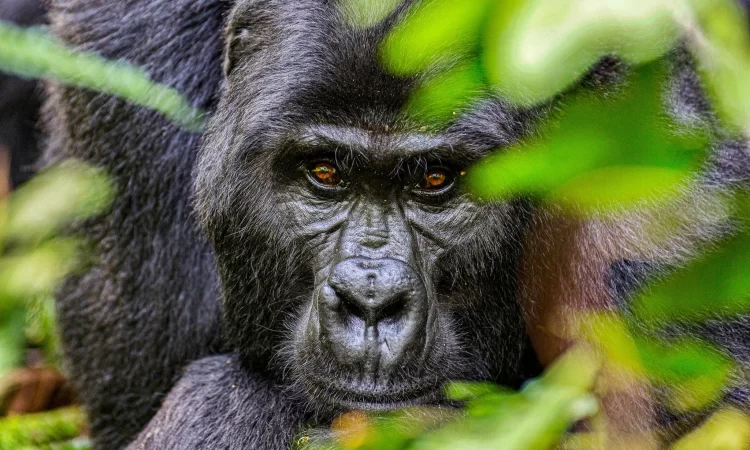
Gorilla photography is defined by low, dappled light that is contrasty and unpredictable even in the middle of the day, and by a ban on flash. Fast lenses and comfortable high-ISO performance matter far more than reach. You will be about seven metres from the animals and sometimes closer when they move, so a lens of 70-200mm or a 24-105mm is usually the most practical choice, with a wider lens for scenes and a fast prime for portraits.
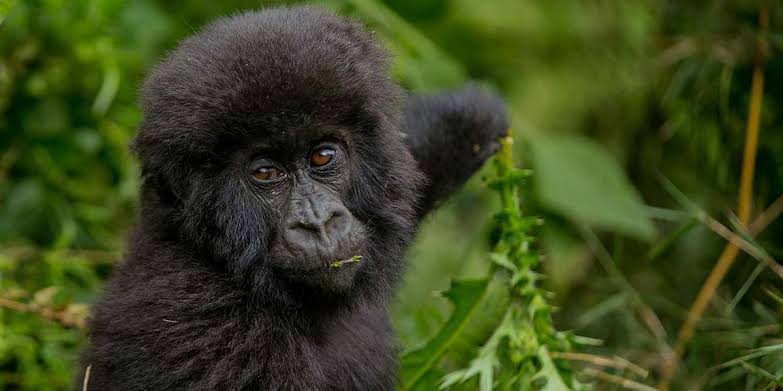
Golden monkeys add a different challenge: they are quick, they move constantly and they live in green bamboo light that can be very dim. A 100-400mm lens or a 70-200mm with a fast shutter speed and burst mode helps, and you should expect many missed frames. Set up your camera before you reach the animals, check your exposure on a test shot and then put your eye to the viewfinder when the moment comes. Our separate guide to golden monkey tracking explains the trek.
Settings That Work in Dim Forest Light
| Setting | Suggested Starting Point | Why |
| ISO | 1600 to 3200, up to 6400 on modern cameras | Forest light is low even by day, and modern sensors handle noise well |
| Aperture | The widest your lens allows | Gathers as much light as possible |
| Shutter speed | As fast as the light allows, at least 1/500 second for gorillas and faster for monkeys | Animals move, and handheld shake adds to blur |
| Focus | Continuous autofocus, with eye detection if your camera has it | Sharp eyes make portraits |
| Stabilisation | On, in the lens or body | Allows handheld shots at slower speeds |
| Exposure compensation | Slightly negative on bright backgrounds and positive on dark fur | Keeps detail in black fur against bright leaves |
| Flash | Off | Flash is prohibited and can disturb the animals |
Black fur is the central exposure problem, so watch your histogram. Wait for the gorilla to look up, since portraits succeed when the eyes are sharp.
Nyungwe: Chimpanzees, Colobus and the Canopy
- Chimpanzees and colobus are often high in the canopy, so a 100-400mm lens or longer gives useful reach.
- Forest light is low and mist is common, so use a high ISO and a fast shutter.
- The canopy walkway, about US$40 in guides, offers an eye-level view of the treetops for birds and light.
- Tripods are impractical on steep, muddy trails, so rely on handheld shooting with stabilisation.
- Protect your gear from humidity with a waterproof bag, silica packs and a cloth.
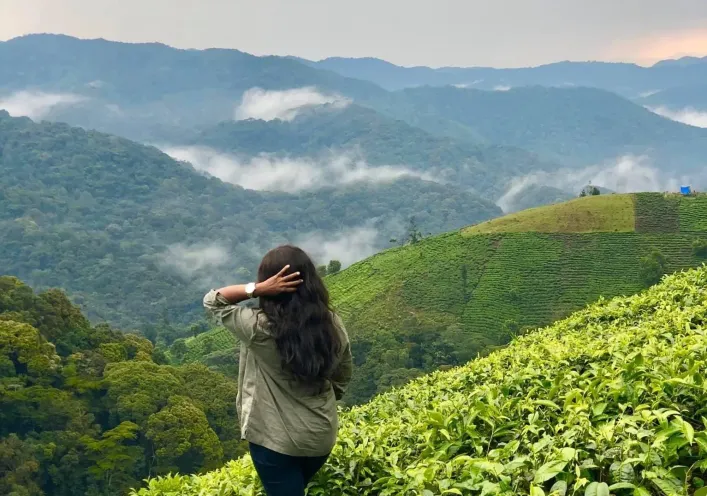
- Mist can make for atmospheric landscape pictures at dawn on the tea estates and ridges.
Nyungwe rewards patience and the right kit more than any other park in Rwanda. Our separate guide to primate tracking in Rwanda explains the chimpanzee and colobus treks.
Akagera: Savannah, Boats and Night Drives
| Situation | Suggested Approach | Typical Settings |
| Game drive in good light | A telephoto zoom with a bean bag on the window | 1/800 to 1/1000 second, f/5.6 to f/8, auto ISO |
| Lions at dawn or dusk | A 100-400mm or longer lens, with backlight in mind | Adjust exposure for rim light |
| Rhinos on foot or from a vehicle | A telephoto zoom, with patience and respect for distance | Fast shutter in shade |
| Boat trip on Lake Ihema | A 100-400mm lens and a wide lens for scenes | About 1/1000 second, f/5.6 to f/8 |
| Night drive | A fast lens and a high ISO, with the guide controlling the light | ISO 3200 or more, with a steady rest |
| Birds | A lens of 400mm or more | A fast shutter, with ISO as needed |
Akagera is the park where reach pays off. A 150-600mm lens is useful for birds and distant wildlife, and early morning and late afternoon give the best light. A night drive, at about US$35 to US$40 in guides, offers a chance at a leopard, owls and genets, and your guide handles the spotlight. Our separate guide to Big Five safaris in Rwanda explains the park.
Gear: What to Bring
- A camera body with good low-light performance, and a second body if you can, for humid forests and quick lens changes.
- A 70-200mm f/2.8 or a 24-105mm for gorillas at close range.
- A 100-400mm or 150-600mm telephoto for Akagera, Nyungwe and birds.
- A fast prime, such as an 85mm f/1.8 or a 50mm f/1.4, for low-light portraits.
- A wide-angle lens of about 14-35mm for volcano and lake landscapes.
- A bean bag for vehicle windows, since tripods are rarely useful.
- Spare batteries, cards, a dust cloth and a waterproof bag, since forest humidity and rain are real risks.
You do not need a super-telephoto lens for most of Rwanda, since primate encounters often happen at close range. Our separate guide to what to pack for a Rwanda safari has a full checklist.
Rules and Ethics
- No flash near gorillas, monkeys or chimpanzees, since it can disturb or alarm them.
- Stay about seven metres from gorillas and follow your guide’s instructions on distance and noise.
- Never bait animals or ask guides to push for a closer view.
- Drones are restricted in the parks, so do not fly one without written permission.
- Ask before photographing people, particularly at cultural villages and the genocide memorial, where photography is not allowed inside the museum.
- Respect communities and do not hand out money or sweets for pictures.
The rules protect the animals and the people, and good photographers treat them as part of the craft. Our separate guide to the Kigali Genocide Memorial explains why some places are not for photographs.
Seasons and Light
| Period | Conditions | Photography Notes |
| June to September | The long dry season | Clearer volcano views, firmer trails and good savannah light, with more visitors |
| December to February | A shorter dry season | Good conditions and popular dates |
| March to May | The long rains, with April the wettest month | Dramatic skies and lush green, with wet, dim forests |
| October and November | The short rains | Fewer visitors and moody light |
| Any month | Forest light is consistently low | Gorilla and monkey photography is possible all year |
The volcano peaks are often clearer in the dry season, particularly early in the morning, and cloud can hide them in the rains. In Akagera, animals gather at water in the dry seasons, which makes them easier to find. Our separate guide to the best time to visit Rwanda explains each month.
A Sample Seven-Day Photography Itinerary
| Days | Place | Focus |
| 1 | Kigali | Markets and street art, with a short city walk |
| 2 to 3 | Volcanoes National Park | A gorilla trek and golden monkeys, with a rest day |
| 4 to 5 | Akagera National Park | Game drives, a night drive and a boat trip |
| 6 to 7 | Lake Kivu or Nyungwe | Islands and dawn mist, or chimpanzees and the canopy |
For more time with the gorillas, check the current rules for any extended experiences. A longer trip can add Nyungwe and the Twin Lakes. Our separate guide to Rwanda safari prices explains the costs.
Frequently Asked Questions
What lens do I need for gorillas in Rwanda?
A 70-200mm or 24-105mm lens is usually the most practical at close range, with a fast aperture for low light.
Can I use flash?
No. Flash is not allowed with gorillas and other primates.
How close can I get to gorillas?
About seven metres, as in the regional rules, with rangers guiding the group.
What is the best park for wildlife photography?
Akagera for Big Five and savannah, and Volcanoes for gorillas and golden monkeys.
When is the best time?
June to September and December to February for clearer views, with early morning and late afternoon for light.